

Voltaire isn’t on the horizon anymore—it’s here. Cardano has entered its government era and completed its first treasury budget round. That milestone closes the chapter on “just building” and opens a more demanding one: governing. The question is no longer whether we can vote, but whether we can run a digital nation with clarity, discipline, and staying power.
For years, Cardano focused on the rails—research, protocol design, core infrastructure, and decentralized funding experiments. Now the conversation must shift from tools to institutions, from proposals to public work. If we truly regard Cardano as a decentralized nation, we must shoulder what nations shoulder every day: routine upkeep, citizen services, and bold, long-term bets on the future. In short—we have real shoes to fill.
Government Functions in a Digital Nation
Political science and urban governance offer a useful lens: any functioning government organizes its work across three broad functions.
Maintenance. The routine, unglamorous, but essential work that keeps society running. Community Services. The programs that give citizens belonging, quality of life, and empowerment. Capital Projects. The visionary, large-scale undertakings that shape the future.
Cardano needs all three.
Maintenance in our world means bug fixes, performance monitoring, and the ongoing care of the Haskell node, Adrestia, and other critical infrastructure. It’s not headline-grabbing—no one campaigns on “fixing potholes”—but if it fails, everything else does too.
Community services span education initiatives, Catalyst efforts, governance working groups, and grassroots programs. This is where citizens engage, learn, and shape culture—our libraries, arts programs, and community centers in digital form.
Capital projects are the big bets: Input Endorsers, post-quantum security, or entirely new protocol layers. Like subways or bridges, they’re costly, high-risk, and high-reward—requiring vision, trust, and long-term planning.
Distinguishing these categories is not academic. It’s a governance necessity. Blur them, and we misallocate resources, underfund infrastructure, and stifle innovation.
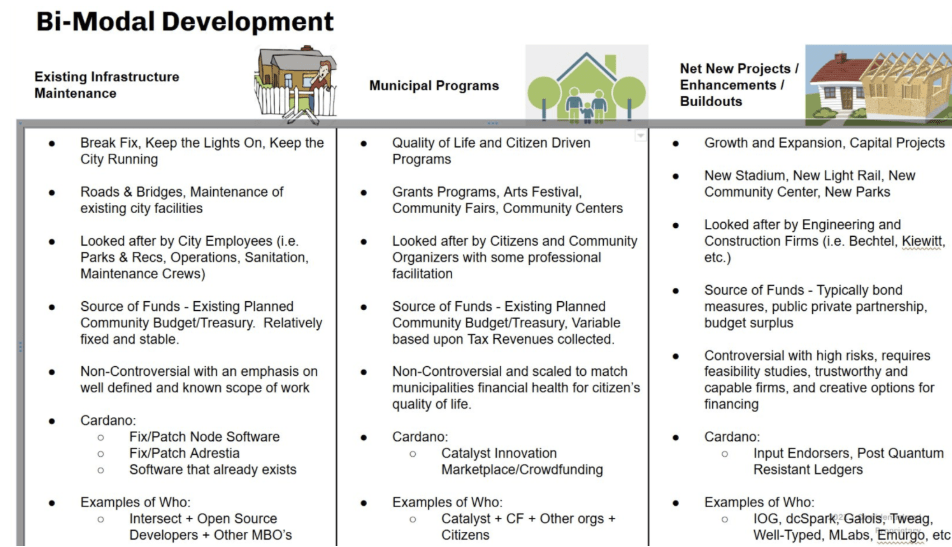
The BiModal Government Model
The BiModal Government Model helps us stop treating Cardano as a loose collection of projects and start running it as a civic system.
- Maintenance needs stable, ongoing funding. A critical bug should never “compete” with an R&D moonshot. Predictable, operating-style budgets keep the lights on.
- Community programs should be flexible and citizen-driven, much like municipal arts or recreation budgets. They scale with treasury capacity and community priorities, thriving on adaptability and diversity.
- Capital projects deserve strategic, long-term funding. Just as cities issue bonds for subways, Cardano must allocate surpluses or dedicated pools for transformative bets—executed by trusted partners and governed through clear milestones.
When we respect these lanes, maintenance isn’t undercut by innovation debates, community services aren’t crowded out by mega-projects, and the treasury process isn’t overwhelmed by treating unlike proposals as if they were the same. The result is order out of complexity—the foundation of effective governance.
Institutions, Not Just Votes
Voting without institutions is a megaphone without a microphone—loud, but unintelligible. Voltaire’s promise will be realized only if we build and empower operational bodies with clear remits:
- Operations & Reliability: Keep core infrastructure healthy, predictable, and documented (service levels, maintenance windows, incident response).
- Education & Community Development: Create skill pipelines, contributor onboarding, events, and curricula—measured by adoption and contributor retention.
- Security & Risk: Run vulnerability management, incident coordination, responsible disclosure, and ecosystem threat modeling.
- Innovation & R&D: Manage a portfolio of strategic bets with phased funding, independent review, and public progress reports.
Today, Intersect covers part of this picture—functioning as an Operations Department stewarding critical infrastructure. That’s necessary but not sufficient. We still need to mature the rest: education, security, innovation, and community development. Clear mandates. Known interfaces. Public accountability.
What the First Budget Round Teaches Us
Our first treasury budget round is a mirror. We can see what worked, what overloaded the process, and where categories blurred. Now we should codify the lanes:
- Guarantee maintenance first. Protect uptime and safety before anything else.
- Ring-fence community programs. Keep participation vibrant with flexible, recurring pools that don’t cannibalize operations.
- Govern capital projects as a portfolio. Stage investments, require independent review, and publish risk/benefit analyses the community can interrogate.
This isn’t centralization—it’s role clarity. Decentralized systems thrive when responsibilities and funding match the nature of the work.
Measures That Matter
To keep this concrete, standardize a minimal, public scorecard for each lane:
- Maintenance: incident counts and time-to-resolution, release cadence, regression rate, documentation completeness, SLA adherence.
- Community: participant growth, contributor retention, program completion rates, learning outcomes, “time to first meaningful PR.”
- Capital: milestone burn-up vs. burn-down, risk-register status, security posture changes, independent review outcomes, projected network impact.
When citizens can read the gauges, they can govern with confidence.
The Call of Voltaire
Voltaire has arrived. The first treasury round is done. The vote isn’t the finish line—it’s the starting gun.
If Cardano is a digital nation, our job is to govern like one:
- Fund the essentials without drama.
- Empower citizens without friction.
- Back big bets with discipline and transparency.
Parts of the machinery are already turning. Now we must complete the rest—new agencies, clearer interfaces, stronger evaluation, and sustained stewardship. That’s how we turn the ideals of decentralization into a society builders can rely on and citizens can trust.
We asked for the shoes. We got them.
It’s time to wear them in.
 Open Source Cowboy Consulting
Leave a comment