
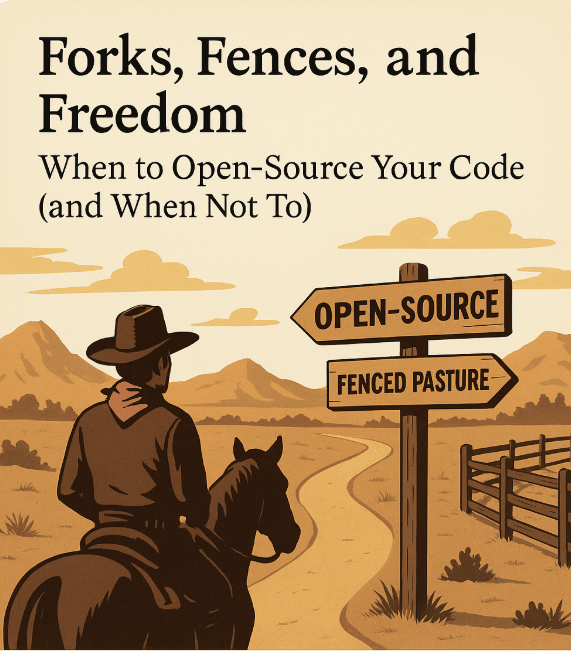
Open source still feels like the wild frontier, a place where code runs free and communities rally behind big ideas.
But every founder eventually hits that fork in the trail:
“Do I open-source this… or keep it behind the fence?”
That question isn’t about ethics. It’s about design, your business design.
Answer it wrong, and you can spook investors, confuse customers, or burn your brand.
Freedom without fences isn’t freedom. It’s drift.
Here’s how to ride that line between openness and ownership in 2025’s shifting landscape.
The Fork: Freedom and Its Consequences
Opening your repo is like opening your ranch gate. It invites collaborators in, but it also lets competitors wander through.
The second you push that code public, you’ve declared who can fork it, copy it, and build on it.
That’s not a problem if you’ve got the right governance and license; it’s empowerment.
Without it, you’re just tossing your IP into the wind.
Take GitLab. It began as a side project, opened its core, and built a thriving community by staying radically transparent. They ran their roadmap in public, took issues openly, and fenced only what added enterprise value.
They didn’t just win; they defined a category. IPO in 2021, billions in valuation, and still one of the most loved DevOps tools in 2025.
That’s what “open done right” looks like freedom with foresight.
The Fence: Protecting What Matters
There’s this romantic idea that “everything open is good.”
But not every line of code belongs on the open range.
Sometimes you’ve got to build the fence before the herd runs off.
Ask yourself:
- Does this code solve a shared problem or give away your advantage?
- Will openness grow your market or arm your competition?
- Can you realistically maintain it in public view?
- Does releasing it expose security or compliance risks?
If the answers aren’t clear, hold back.
Try InnerSource, or Open Core; open the foundation, keep differentiators behind the gate.
Look at Elastic. They dominated open-source search under Apache 2.0.
But when cloud giants began reselling their work without giving back, Elastic changed course.
The license shift protected revenue but fractured trust, leading to OpenSearch.
Elastic recovered, sure, but the split never fully healed.
Fence too late, and you lose goodwill.
Fence too tight, and you lose momentum.
The trick is timing, not fear.
The Freedom: What You Gain by Going Open
When you open the right things, you amplify reach, reputation, and resilience.
Open ecosystems turn customers into collaborators.
Your code becomes shared infrastructure, not a closed product.
And shared infrastructure doesn’t compete, it compounds.
Think Kubernetes under CNCF governance: no single owner, just shared accountability.
Or PyTorch, open-sourced for community growth while companies like xAI or OpenAI fence their proprietary layers.
Openness builds gravity.
It’s how projects outlast companies.
Forks Don’t Pay the Bills
GitHub stars are nice, but they don’t pay salaries.
Adoption means nothing if you can’t convert it into sustainability.
Align your open/fence mix with your stack layer:
| Layer | Buyer Type | Monetization Fit | Example |
|---|---|---|---|
| Infrastructure | CTOs, SREs | Support contracts, SLAs, enterprise subscriptions | Red Hat |
| Middleware / Frameworks | Developers, ISVs | Dual licensing, premium extensions | MongoDB, Timescale |
| SaaS / Managed Service | IT, Ops | Subscriptions, hosting, integration tiers | Confluent |
| Developer Tools | Individuals, Teams | Freemium → paid teams, usage tiers | GitHub, VS Code |
Your open core builds trust.
Your fenced features fund the mission.
Your service layer keeps the lights on.
HashiCorp, Grafana, and others learned that clarity early keeps communities stable; even through license turbulence.
Knowing When to Open and When to Hold
Every repo, every module, every feature has a lifecycle.
Release what accelerates your ecosystem.
Guard what preserves your edge.
Once you open something, it’s out there forever. So make sure it’s for the right reasons.
Strategic transparency beats impulsive virtue every time.
The Cowboy Way
A cowboy doesn’t fence every acre, but he sure knows where the herd sleeps.
That’s the real heart of open-source strategy: stewardship, not surrender.
Freedom without governance breeds fragility.
Fencing without openness breeds stagnation.
Balance breeds sustainability.
In 2025, AI, cloud economics, and evolving community norms are rewriting the rulebook.
The projects that thrive will be the ones that build trust before contracts and govern before they monetize.
So if you’re standing at that same fork, wondering whether to open or hold; maybe it’s time to ride with someone who’s mapped the trail.
So if you need help determining what to do here, reach out to your local open source cowboy.
You need a map and someone who’s ridden that trail before.
 Open Source Cowboy Consulting
Leave a comment