
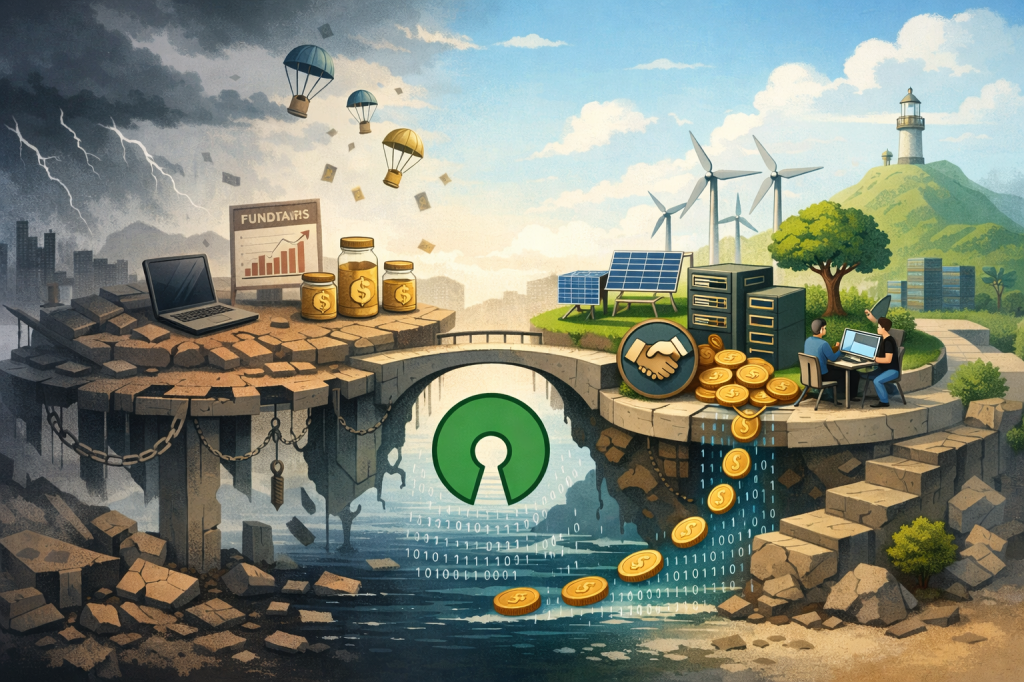
Open source software powers nearly everything digital: smartphones, cloud platforms, banking systems, and even government services. Yet many of the most critical projects—those relied on by millions or billions of people—are maintained by small teams, volunteers, or individual contributors without reliable funding.
This imbalance has led to more serious discussion about what sustainability actually means in open source, and whether the common approaches in use today are sufficient for long-term health.
A key distinction that helps clarify this debate is the difference between sustainability and self-sustainability. While the terms are often used interchangeably, they describe fundamentally different models.
Sustainability vs. Self-Sustainability
Traditional sustainability typically relies on external and often time-limited sources of funding, such as:
- Grants and one-off awards
- Corporate sponsorships
- Philanthropic donations
- Fundraising campaigns
These mechanisms can be effective for launching projects or addressing short-term needs. However, they are often unpredictable. Maintainers may spend significant time applying for funding rather than maintaining software or addressing security issues. When funding ends or priorities change, work can slow or stop, even when the software remains widely used.
Self-sustainability takes a different approach. Instead of depending primarily on external funding, it builds financial support into the ecosystem itself:
- Revenue comes from users, beneficiaries, or network activity
- Maintenance is treated as a routine operational expense
- Support scales with real usage and delivered value
- Key roles—such as maintainers, security responders, and coordinators—are recognized as essential, ongoing work
The goal is not profit, but continuity: ensuring that critical software can be maintained, secured, and improved over time without constant fundraising.
What Self-Sustainability Looks Like in Practice
Across different ecosystems, effective self-sustainability models tend to share several characteristics:
Built-in revenue streams
Funding comes from mechanisms such as membership dues, service fees, ecosystem treasuries, or dedicated public budgets, rather than sporadic donations.
Transparent governance
Clear, community-driven processes determine priorities and spending, with visibility into how decisions are made and resources are allocated.
Maintenance as core infrastructure
Security updates, dependency management, and coordination are funded as necessities, not optional volunteer efforts.
Multi-year stability
Funding supports predictable operations and long-term planning, rather than short-term bursts of activity.
Example: Cardano and Intersect
One commonly cited example of this approach is the Cardano blockchain ecosystem.
Cardano includes an on-chain treasury funded by network activity. These funds are allocated through governance processes to support ecosystem needs, including open source infrastructure. Rather than relying on external sponsors or donations, funding is generated internally and distributed according to community-defined priorities.
Intersect, a member-based organization within the ecosystem, helps coordinate the use of these funds across areas such as:
- Ongoing maintainer support for critical repositories
- Targeted funding for features and fixes
- Security coordination and audits
- Contributor onboarding and progression frameworks
This model aims to align funding directly with ecosystem usage and long-term responsibility, treating open source software as shared, self-funded infrastructure.
Proven Examples Beyond Blockchain
Similar principles appear in other open source environments:
Linux Foundation
The Linux Foundation is primarily funded through corporate memberships. These contributions support staff, infrastructure, security initiatives, and long-running projects, including the Linux kernel. Funding is tied to enterprise reliance on the software.
Apereo Foundation
Apereo supports open source education platforms by offering paid services such as consulting, training, and custom development. Revenue generated from ecosystem expertise is reinvested into project maintenance and community support.
Germany’s Sovereign Tech Agency
Germany’s Sovereign Tech Agency provides ongoing public funding for critical open source components, treating them as national digital infrastructure. Investment focuses on maintenance, security, and resilience rather than short-term innovation grants.
These examples demonstrate that sustained investment is possible when funding responsibility is designed into the system.
Why the Distinction Matters
When open source projects rely exclusively on temporary or external funding, several risks increase:
- Maintainer burnout due to unstable compensation and workload
- Delayed security fixes and neglected dependencies
- Gradual degradation of widely used but underfunded software
Self-sustainability does not eliminate all challenges, but it reframes open source as infrastructure that must be actively operated and maintained over time.
Bottom-Line Takeaway
For individuals, organizations, and governments that depend on open source software, the takeaway is straightforward:
If software is critical, its maintenance requires stable, built-in funding.
Self-sustainability is one approach ecosystems are using to meet this need—by linking funding mechanisms, governance, and long-term stewardship so that responsibility and benefit are aligned.
Sources
- Patrick Masson, Sustainability vs Self-Sustainability in Open Source
https://www.linkedin.com/pulse/sustainability-vs-self-sustainability-open-source-why-patrick-masson-fcuce/ - Cardano Ecosystem Budget Overview
https://forum.cardano.org/t/overview-a-cardano-blockchain-ecosystem-budget/143049 - Intersect — Paid Open Source Model
https://www.intersectmbo.org/news/the-paid-open-source-model - Linux Foundation Overview
https://en.wikipedia.org/wiki/Linux_Foundation - Sovereign Tech Agency (Germany)
https://en.wikipedia.org/wiki/Sovereign_Tech_Agency
 Open Source Cowboy Consulting
Leave a comment